
A Brave New 1984
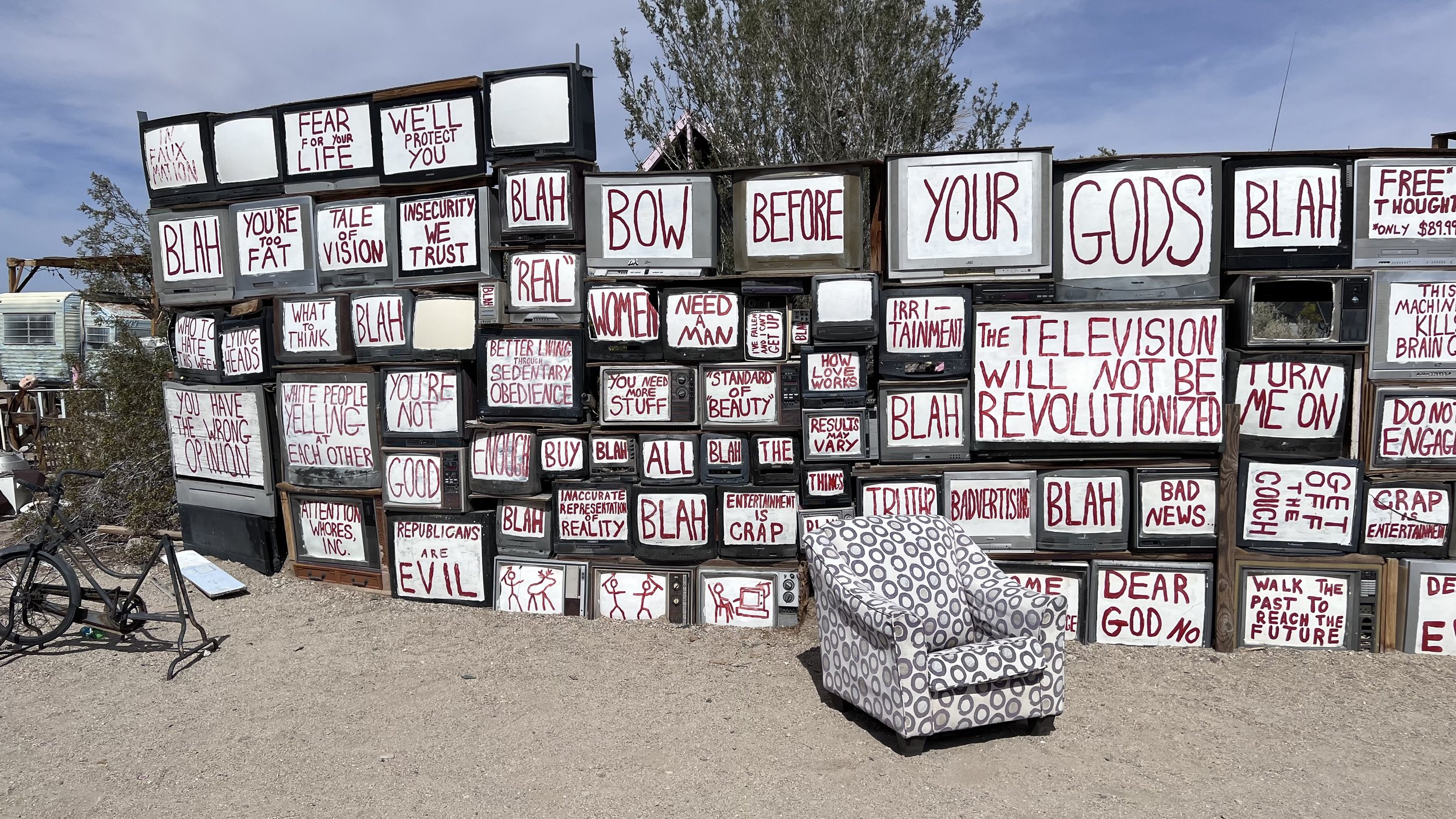
Slab City
Every once in a while, a conversation surprises you. Today’s Context Salon was one of those.
What We Discussed
Dystopia, Imagination, and the Work of Getting Free
We came in with a framework — Orwell versus Huxley, hard power versus soft seduction — and left with something more unsettling: the recognition that the dichotomy itself might be the distraction. What we’re living inside isn’t one model or the other. It’s both, running simultaneously, and the system is so efficient at this point that most of us consent to it willingly.
That was the thread Léon pulled on first, and it didn’t let go. The algorithms don’t need to surveil us in the Orwellian sense because we hand over the data ourselves. We stay inside the dopamine loop because it was engineered to feel good. The cage is comfortable. That’s the point.
“If we become low energy to maintain and manage, then the system can be redesigned easily. But if we take a lot of energy to manage and maintain… we don’t become easily digestible by the system.”
— Léon
Léon’s framing reoriented something for me personally. I’ve spent a lot of time thinking about the failure of institutions — of government to curate public life, to hold the line against the commodification of everything. And I still believe that. When I said we need someone to help cultivate society, I meant it. Left entirely to individual pursuits, we tend toward self-interest in ways that hollow out the collective. That’s not cynicism; that’s observation.
But Léon pushed back on where I was locating the problem. The issue isn’t only incompetence or even conspiracy — though both exist. The issue is imagination. Or rather, its absence.
“It’s easier to imagine the end of the world than it is to imagine the end of capitalism.”
— Léon, citing Mark Fisher
That line — borrowed from Fisher — landed like it always does. We’ve outsourced our futures to post-apocalyptic fiction. Our cultural output keeps rehearsing collapse because we’ve collectively lost the muscle for envisioning something genuinely different. And if you can’t imagine it, you certainly can’t build it.
Kwesi brought the historical grounding that conversation needed. His point that the world hasn’t changed — that we’ve simply all started seeing it more clearly, collectively — felt true in a way that was both clarifying and heavy. Authoritarianism doesn’t announce itself. It rhymes. And we’re living inside a very recognizable verse right now.
What I found most generative was the pivot toward what actually works. Not national politics, which feels increasingly like a theater of managed frustration. The neighborhood. The block. The “united neighborhood” as the unit of meaningful change — something Kwesi articulated in a way that called back to the Black Panthers feeding people on corners before anyone in Washington noticed hunger was a crisis. That’s where imagination has always been most alive: at the scale where people can actually see each other.
Léon’s prescription — contemplative traditions, metaphysics, the recovery of the mystical — might sound abstract. But I think it’s pointing at something real: the difference between a person who has an inner life and a person who has been fully colonized by their feed. Micro-noncompliance, data sovereignty, choosing the sandwich over the franchise — these aren’t symbolic gestures. They’re friction. And friction is exactly what a system built on frictionless compliance cannot easily absorb.
I’m still sitting with the question of what institutions can do versus what they’re constitutionally incapable of doing at this moment. I don’t think we’ve resolved that. But today felt like the beginning of a different kind of answer — one that starts not with systems but with people who still know how to imagine.
That’s what this Salon is for.
Threads from today’s conversation
The convergence: Orwell and Huxley aren’t opposites anymore — they’re layers of the same operating system.
The crisis: Society has lost its capacity to imagine a desirable future — only collapse feels plausible.
The scale: The neighborhood, not the nation, is where real change remains possible.
The practice: Micro-noncompliance and contemplative traditions as acts of structural resistance.
Read the notes, review the deliverables, and listen to the Deep Dive podcast in the Notebook.
Follow The Context Salon on Substack
Follow Hey, Slick! on Substack to hear more from the inimitable Léon de Sailly
Upcoming Salon
Previous Salons

Chile, 1973. A control room, a coup, and the question we carried all day: what if things had gone differently?
Joel opened where this began for him, a high school classroom in the early ‘80s, learning what happened to Allende's Chile and to Stafford Beer's Project Cybersyn, the cybernetic experiment that tried to run an economy on real-time feedback before the world had the machinery for it. Not nostalgia, he reminded us. The road not taken can still teach us how to choose.