
Propaganda: Technology’s Siamese Twin
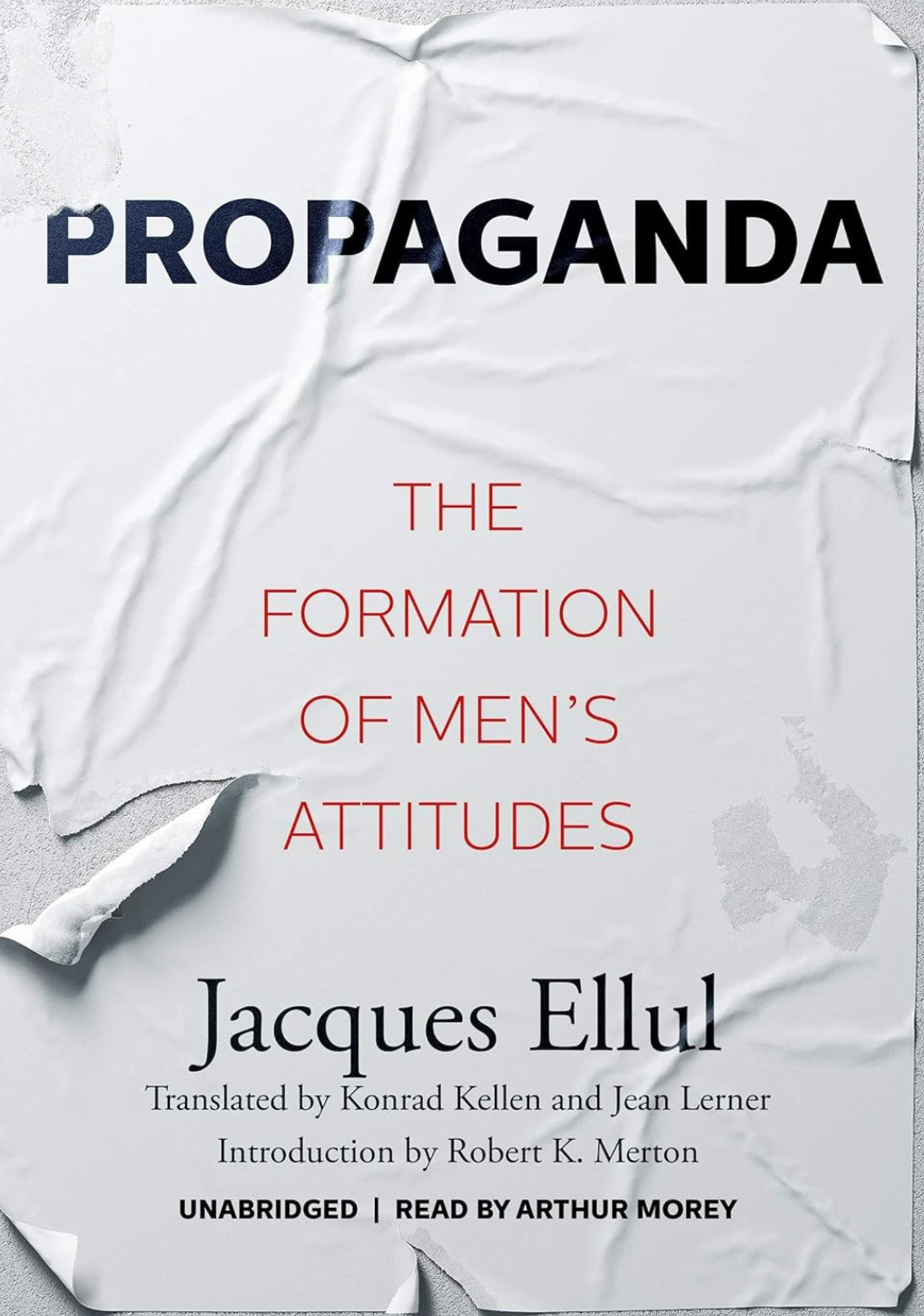
In Jacques Ellul’s 1965 work Propaganda: The Formation of Men’s Attitudes, Ellul essentially states that technology gives us the feedback loop for propaganda to pervade our being.
Changing opinions is secondary for propaganda. Intensifying feelings to get immediate action is the point. Ironically, the most effective action of propaganda is inaction. The most effective propaganda encourages you to do nothing.
Ellul states that propaganda is not a bug in our technological society, it’s a feature. And it’s necessary to give mass society some sort of cohesion.
What We Discussed
Propaganda as Universal Communication
Propaganda is fundamentally a form of communication. It was posited by a speaker in the Salon that all communication can be seen as propaganda.
This broad view stems from the acknowledged universality of bias:
• The dictionary definition of propaganda includes "information, especially of a biased or misleading nature".
• However, since there is "no human who's not biased on any issue," bias is inherent in communication.
• Even when a person writes a memoir, they are simply communicating their own perspective.
• The term "misleading nature" found in definitions might be misplaced, as the nature of communication is arguably leading—it attempts to convey a viewpoint, whether actively promoting it or not.
Propaganda as the Foundation of Belief Systems
The discussion repeatedly drew parallels between communication and deeply held, unprovable belief systems—specifically religion and politics—arguing that such systems are foundational forms of propaganda.
• Religion as Original Propaganda: Religion is described as "the original propaganda". Organized religion, regardless of its basis, begins as propaganda because it establishes core beliefs and values: "this is the way we think, this is right, everybody else is wrong".
• Dogma in Politics and Religion: Politics and religion are seen as fundamentally similar because they both rely on positions that cannot be strictly proven. Since people must stick to these positions using their best judgment, both religion and politics are characterized as forms of dogma.
Questioning the Pejorative View
While the overall discussion moved away from automatically labeling propaganda as bad, speakers frequently used the term pejoratively when discussing entrenched belief systems.
The discussion defined propaganda so broadly that its inherent pejorative status was challenged; if "all communication can be seen as propaganda," then the word simply describes the nature of biased input.
However, the term remains strongly pejorative when used to critique actions that involve mindless adherence to dogma (religious or political) or the transmission of harmful, amplified biases (such as those found in AI training data).
Read the notes, review the deliverables, and listen to the Deep Dive podcast in the Notebook.
Upcoming Salon
Previous Salons



Chile, 1973. A control room, a coup, and the question we carried all day: what if things had gone differently?
Joel opened where this began for him, a high school classroom in the early ‘80s, learning what happened to Allende's Chile and to Stafford Beer's Project Cybersyn, the cybernetic experiment that tried to run an economy on real-time feedback before the world had the machinery for it. Not nostalgia, he reminded us. The road not taken can still teach us how to choose.